


👋 Hiya, work bestie!
You know that sick feeling you get right before an interview? The one where you’re convinced you’re the World’s Biggest Imposter and you’ll probably throw up all over your keyboard on this Zoom call?
Yeah, I used to feel that way.
But now, here’s how I keep my lunch where it belongs.
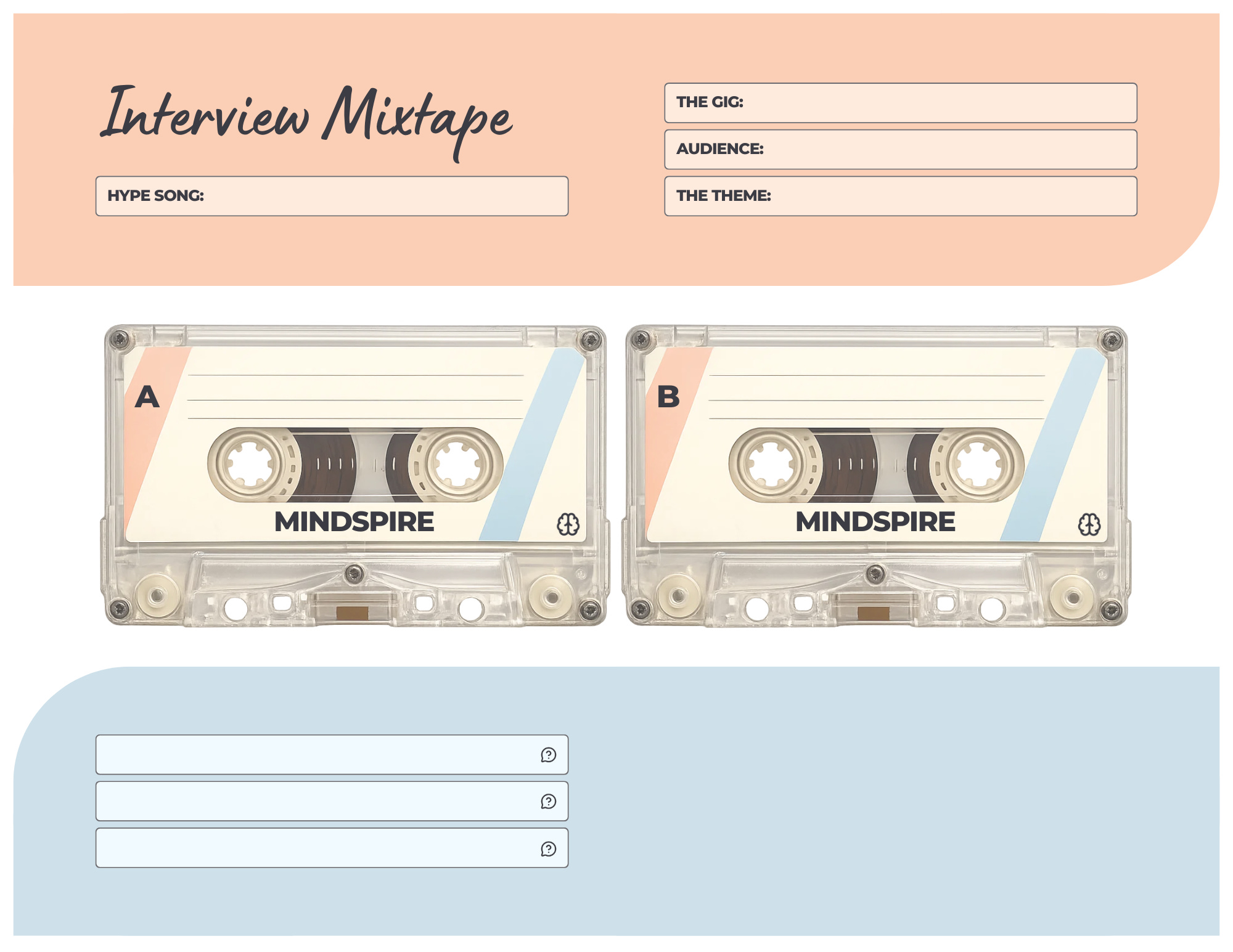

Interview Mixtape
I print out this mixtape template the night before every interview. I can usually work through it in about 30-60 minutes. But then I can go to sleep knowing I’ve got the perfect playlist to pop in tomorrow to boost my confidence.
The Gig: This is just the company and role you’re interviewing for.
Audience: These are the specific people who’ll be in the interview.
The Theme: This is the overarching thing that they’ll be evaluating.
The A/B Sides of Your Career
Think of the A-side as the good times where you really shined. The B-side is the dark times where you got beat up a little, but learned a lot.
Here’s the thing: you’ve got tons of stories you could tell. So when your audience hits you with one of those inevitable “Tell me about a time when...”, you’re likely to come down with a case of analysis paralysis as your entire career flashes before your eyes.
My life hack... choose your stories beforehand. And by that I mean pick one A-side and one B-side story and limit all of your responses to just those.
Poof, you’ve just lowered your heart rate by 45 bpm.
Now when your audience asks, you just have to decide if your A or B-side is a better fit for the scenario. And then what angle of the story you’re going to tell.
But that sounds too easy, right? And what if they ask about more than two scenarios? Or your story doesn’t perfectly match their prompt?
It is in fact that easy. Nearly every behavioral interview question falls into one of two buckets: showing what you’re capable of (A-side) or demonstrating resilience and growth (B-side). The key is choosing bigger, stronger stories that can stand up to more than one scenario.
And don’t worry about circling back to the same story. That’s actually a good thing. Your audience already has some context as a jumping off point. And they get a fuller picture of what it’s like to work with you than a bunch of disjointed, vague examples.
And close enough is good enough. Just tell your story. They care more about how you think and communicate than getting a pixel-perfect answer. If they need more, they’ll ask for more.
Pro tip: Test your stories beforehand. Ask AI for 50 examples of “Tell me about a time when…” prompts based on the theme of this interview. Go through the list and see if you can quickly decide which story you’d pick and the angle you’d use. If you’re getting stuck a lot, you probably haven’t found the right stories yet.
Three Good Questions
Here’s another way to stand out: come up with three good questions. These are questions that make your audience say “That’s a good question,” and then pause for a few seconds while they think about their answer.
It’s a bad look if you don’t have anything to ask, but it’s also not helpful if you’re just regurgitating every other candidate’s throwaway questions.
For example: “I noticed the team recently switched from X to Y framework, what drove that decision?” is way better than “What technologies does the team use?” The first shows you’ve done your homework and you’re thinking critically. The second could’ve been answered by skimming the job posting again.
More inspiration: look at your audience’s LinkedIn profiles, at the company’s Glassdoor reviews, or just pretend this is your second week at this gig. What sorts of things would you be asking your audience?
Hype Song
One last thing (and this might sound weird):
Pick a hype song. Then right before you get on the call, blast it at full volume and move your body. Dance. Do jumping jacks. Go full inflatable tube man like at a car dealership and wave your arms around.
I know it sounds ridiculous, but getting your body moving literally changes how you feel. Our bodies and minds are connected in ways we don’t even understand. Get your energy up. Get your blood flowing. And you’ll show up as the version of yourself you want them to meet.
The deep dive? If you need even more help with what to do before, during, and after the interview, grab a copy of The Job Closer by Steve Dalton. You'll also want to check out the FIT Model and CAR Model that he and his former colleagues at Duke University put together.
You got this,
✌️ Steve
PS That extra space at the bottom? All yours for notes. And keep your mixtapes throughout your job search. You’ll start to see patterns in what’s working and what’s not as you go from interview to interview.